
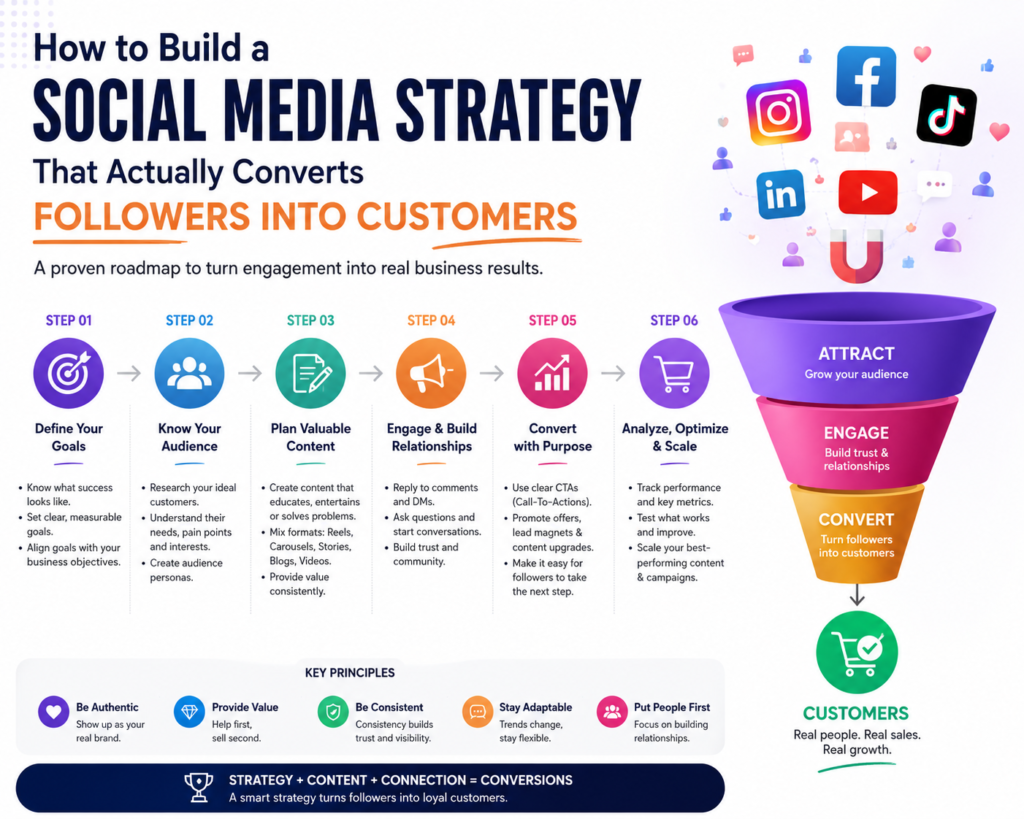
Most businesses have social media pages. Very few actually make money from them. If your follower count keeps growing but your sales aren’t moving, you don’t have a content problem — you have a social media strategy problem. In this step-by-step guide, you’ll learn a proven framework to convert followers into customers using a structured social media marketing strategy — not guesswork, not hacks, but a system that works.
Whether you’re a small business owner, a freelance digital marketer, or a startup founder, this guide will walk you through everything: from defining your audience to building a social media salesfunnel that drives consistent sales. Let’s get started.
Why Most Social Media Strategies Fail to Convert
Here’s the hard truth: growing a business on social media isn’t about posting daily or chasing viral reels. Brands pour hours into content and still see zero social media ROI. Why? Because they treat social media as a broadcast channel — not a conversion engine.
A high follower count means nothing if those followers never take action. The difference between a brand with 5,000 engaged customers and one with 500,000 passive scrollers is strategy — specifically, a strategy built around the buyer journey.
| Content without strategy is just noise. Strategy without content is invisible. You need both — aligned around one goal: conversion. |
Step 1: Define Your Goal and Know Your Audience
Before creating a single post, you need clarity on two things: what you want to achieve and who you’re talking to. Vague goals like ‘more engagement’ don’t pay bills. Specific goals like ‘generate 50 qualified leads per month via Instagram’ do.
Build a customer avatar — a detailed profile of your ideal buyer. Ask yourself these questions:
• What specific problem does my product or service solve for them?
• Where do they spend time online — Instagram, LinkedIn, YouTube?
• What kind of content makes them stop scrolling?
• What objections do they have before making a purchase?
• What does their buying journey look like — impulse or research-heavy?
| 💡 Pro Tip: Use Instagram Audience Insights or Facebook Audience Manager to validate assumptions about your target audience before investing in content creation. |
A deep understanding of your audience is the foundation of any social media marketing strategy that drives revenue. Without it, your content is just noise. Spend as much time on this step as you do creating content — it will pay off exponentially.
Step 2: Choose the Right Platforms — Not All of Them
One of the biggest mistakes brands make is trying to be everywhere at once. Spreading yourself thin across six platforms is a guaranteed path to mediocre results on all of them. To increase social media conversions, focus on 2–3 platforms where your audience actually lives and buys.
Platform Guide by Business Type
• Instagram & Pinterest — Best for visual products, fashion, food, lifestyle, and B2C brands. High purchase intent when paired with Shopping features.
• LinkedIn — The go-to for B2B social media lead generation, professional services, and SaaS companies. Organic reach remains strong here.
• YouTube & TikTok — Ideal for long-form education (YouTube) and short-form discovery (TikTok). Both drive high engagement with consistent content.
• Facebook — Still dominant for community building, local businesses, and paid advertising with detailed audience targeting.
| 💡 Pro Tip: Master one platform first. Consistent quality on two platforms beats thin content across six — every single time. |
Choose your platform based on where your ideal customer spends time, not where your competitors are. Then build your presence with intention before expanding to other channels.
Step 3: Build a Content Strategy That Converts
Not all content that converts looks the same — but it all follows a formula. Every piece of content should serve one of three purposes: Attract, Nurture, or Convert.
Attract Content (Top of Funnel)
This is your awareness content — educational posts, entertaining reels, trending topics, and value-packed carousels. The goal is to bring new eyes to your brand. Examples: ‘5 mistakes you’re making with your Instagram bio’ or ‘How we grew a brand from 0 to 10k followers in 60 days.’
Nurture Content (Middle of Funnel)
This is where trust is built. Share behind-the-scenes stories, founder journeys, client case studies, and detailed how-to content. This content answers the question: ‘Why should I trust this brand?’ It is the critical middle layer of your social media sales funnel.
Convert Content (Bottom of Funnel)
This is where you make the ask. Product demos, testimonials, limited-time offers, free consultations, and direct CTAs. Many brands skip straight to this stage without warming up their audience — and then wonder why their posts get no sales.
| Content that converts doesn’t sell immediately — it earns the right to sell by delivering value first. |
A strong starting content ratio: 60% attract, 25% nurture, 15% convert. Adjust based on your audience’s engagement data over time. The goal is to earn trust before asking for the sale.
Step 4: Build a Social Media Sales Funnel
The biggest insight that separates expert marketers from beginners is understanding that social media is not a closing tool — it’s the top of a funnel that leads to conversion. Your social media sales funnel should move prospects through four stages:
1. Awareness — Reels, short videos, and trending posts attract cold audiences.
2. Interest — Carousels, stories, and threads deepen connection and showcase expertise.
3. Consideration — Testimonials, case studies, and FAQs address objections and build trust.
4. Conversion — DM campaigns, landing pages, story swipe-ups, and paid ads drive the sale.
The critical mistake most brands make is sending cold followers directly to a product page and expecting sales. Instead, guide them through the funnel with deliberate content — warming them up before the ask. This is the core of social media lead generation done right.
| 💡 Pro Tip: Use Instagram Stories polls and question stickers to qualify leads organically. Engaged story viewers are often your warmest prospects — and easiest to convert. |
Step 5: Use Calls-to-Action That Drive Real Action
A post without a clear call-to-action is a missed opportunity. If you want to convert followers into customers, you must tell your audience exactly what to do next — and make it as easy as possible for them to take that step.
Weak CTAs vs. Strong CTAs
• Weak: ‘Like this post if you agree’ or ‘Follow for more tips.’
• Strong: ‘DM me STRATEGY and I’ll send you a free audit.’
• Strong: ‘Click the link in bio to book your free 30-minute consultation.’
• Strong: ‘Drop your biggest challenge below and I’ll reply personally.’
Match your CTA to the stage of the funnel. Awareness posts can ask for a save or share. Nurture posts should invite conversation. Conversion posts need a single, clear action with a compelling reason to act now — urgency, exclusivity, or clear value.
Step 6: Leverage Social Proof and Trust Signals
Before a follower becomes a customer, they need to answer one question: ‘Can I trust this brand?’ Social proof is your most powerful tool to answer it. In a world saturated with noise, trust is the currency that drives engagement to revenue.
High-Impact Social Proof Strategies
• Client Testimonials — Short video testimonials perform 3–5x better than text reviews on social media. Feature real names, real results, and specific outcomes.
• Case Studies — Posts like ‘I helped [Client X] grow from 1,000 to 25,000 followers in 90 days — here’s how’ build instant credibility and demonstrate expertise.
• User-Generated Content (UGC) — Reposting content from happy customers turns your audience into a marketing team. It’s authentic, free, and incredibly persuasive.
• Behind-the-Scenes Content — Showing the real people, processes, and values behind your brand humanises it and builds emotional connection with potential buyers.
| People buy from brands they know, like, and trust. Social proof accelerates all three — and makes your social media strategy dramatically more effective. |
Step 7: Measure, Optimise, and Scale Your Strategy
A social media marketing strategy is never finished — it evolves. The brands that consistently grow their business on social media treat their analytics like a feedback loop, not a report card. They measure what matters, cut what doesn’t work, and double down on what drives results.
Key Metrics to Track Weekly
• Click-through rate (CTR) — Are people taking action on your posts?
• Reach and impressions — How many unique people are seeing your content?
• Conversion rate — What percentage of visitors from social media become leads or customers?
• DMs and inbound leads — Are your posts generating real conversations?
• Revenue from social media — Use UTM tracking links to attribute sales directly to posts.
Track these metrics to measure your true social media ROI. Double down on content formats and topics that generate leads. Run A/B tests on CTAs, captions, posting times, and content formats. The goal is not a perfect strategy on day one — it’s a smarter strategy every month.
| 💡 Pro Tip: Use UTM parameters in your bio links to track exactly which social posts are driving website traffic and sales in Google Analytics. This is the clearest way to prove social media ROI. |
Putting It All Together
Here’s the truth about social media lead generation: it’s not a sprint — it’s a system. Businesses that successfully increase social media conversions aren’t luckier. They’re more intentional. They know their audience, show up consistently, guide followers through a funnel, and measure what matters.
The 7-step framework in this guide isn’t theory. It’s a repeatable process you can apply to any brand, any niche, and any platform. Start with step one. Build your audience avatar. Pick your platforms. Create content with purpose. Build the funnel. Add strong CTAs. Layer in social proof. And track real results — not just likes.
Remember: the goal of every post is not to go viral. It’s to move someone one step closer to becoming a customer. That’s the difference between a social media strategy that looks good and one that actually converts followers into customers.
| Key Takeaways• Define clear goals and a specific audience before creating any content.• Pick 2–3 platforms where your audience actually lives — not all of them.• Use the Attract–Nurture–Convert content framework for every post.• Build a social media sales funnel — not just a feed.• Strong CTAs and social proof are what turn passive followers into paying customers.• Track revenue-tied metrics, not vanity metrics. Optimise every month. |
— End of Article —